Thursday, April 18, 2013

CREATION, COLLABORATION AND UNINTENTION


Creation, that is to say the act of creating, has always intrigued me. Specifically, where does the genesis of the Idea come from?  Often times, it is generated by the need to solve some posed problem or resolve some issue. The seed idea is created through the intentional actions that are born out of the need to resolve or respond to some dynamic force or action with a set of defined goals.  This is the process that enabled man to fly with the evolution of airplane, and a tiny little robot to land and explore the desolate grounds of Mars. But not all creation is generated with a specified goal in mind, or is a response to a problem that needs resolution.  Other acts of creation, be it the writing of a book, composing of song or creation of a sculpture. Most often, but not always, the idea is not generated with a specific goal in mind. It is born through random imaginings and organic exploration. The act of creating becomes a dynamic process where the end result is unknown and the possibilities endless. In many instances there is an accidental aspect to the process where something is simply discovered with absolutely no prejudice of thought or intent.  I have often thought that it is these products, regardless of what they may be, are the most intrinsically honest and the most intriguing specifically because of the absence of artistic prejudice and intent.
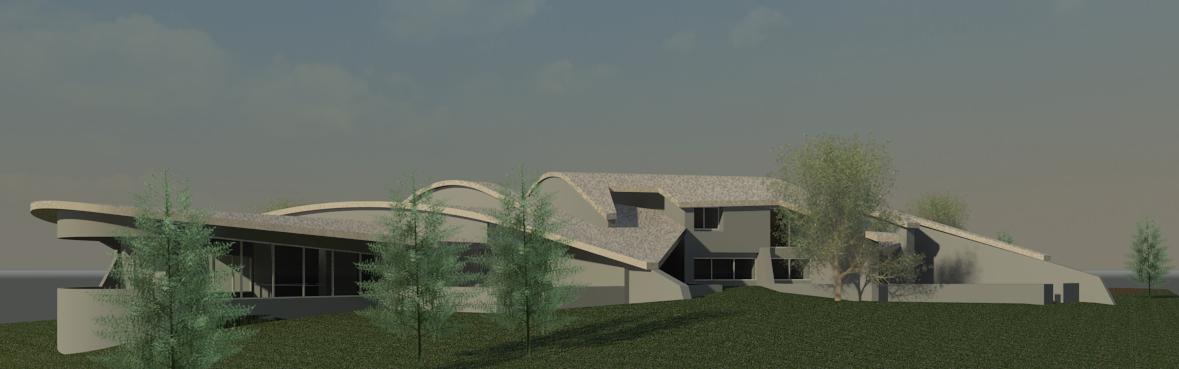
Below is a series of images that were created from the elevations of a house that I am designing. As anybody within the architectural industry knows, building elevations are simply a tool to convey information to the contractor on what to build. Elevations are simple diagrams that display heights, indicate material, and so forth. Obviously, as I am designing the house, artistic intent and aesthetic judgments are being infused into the design as it evolves, but not necessarily as a flat composition of elements that visually interact with each other. The other aspect of the images below that I find intriguing is that they are products of collaboration between man and machine.  The collaboration of a machine (Asus laptop and Revit software) interpreting and rendering, within its graphic limitations, an object that I designed. In other words, if I decided to specifically to render these elevations either by hand, or with some software program, the result would not have been the same. There are things the computer either couldn’t understand, and utilized its default settings, that I simply would not have thought of, even if I were trying to create a composition of 2dimensional elements with varying colors, rhythms and textures.  
Strip the elevational aspect away from the images below and they become something else, something that was discovered by accident, through a collaboration of man and machine. I find the results most intriguing and reinforce the notion that the idea, the very act of creation, the genesis of discovery and exploration, is often by mere chance…..


And yes, the overlap of the black border is also by accident, and only reinforces the notion of this post!
RBP
4.18.13

Monday, April 15, 2013

DOES DESIGN MATTER-2nd POSTING


Sometimes, It's already been said.......and when that happens, you just say it again!

Does design matter? A simple question really….or at least it’s a simple question to ask, but not all that simple to answer.


The question was posed to me by a friend over coffee and a bagel one morning. We were having a discussion about the quality of homes in a particular neighborhood.  I of course retreated to my architecturally trained and knee jerk response of “Hell yes it matters”! And then I was greeted with that ever so common and most annoying question. “Why?” I answered of course, but in all honesty, was not satisfied with my response. My response was not confident and I realized that I have never honestly reflected on a personal level why design, that is to say high quality good design matters to me, and by extension to the public, society and civilization.


Design, at is base and core level, is a thoughtful response to a problem. In other words, design is process that leads to an answer to a problem or question. Believe it or not, cavemen were designers. Primitive designers yes (pun intended), but still designers.  Intuitively, they realized that in order to survive, they had to become hunters, and the more efficient hunters they were, the stronger and healthier they became.  They became aware through trial and error (life and death) that it was better to attack an animal with a pointed stick as opposed to a blunt stick. It took less energy, and the pointed stick could penetrate the animals hide easier than the blunt stick could.  The problem: How do we kill an animal and provide food for the clan. The answer: Use sticks that have pointed edges as opposed to blunt sticks. They arrived at that conclusion through a process of investigation, trial and error and thought. They began to look for sticks that had sharper points, and then began to shape it themselves by scraping the end against a rock until the point became sharp. They designed a better weapon to attack an animal with.  They then realized that the weapon would be even better if the tip of the stick had a hardened edge, fashioned and shaped from stone that was then tied to the end of the stick. They now had the ability to pursue and hunt bigger game with tougher hide that their weapons could now penetrate. Without that process, the trial and error; the weapon would not have improved. Without the inspiration to attach a pointed stone to the tip of a stick, there would be no improvement to the weapon, and they could not hunt bigger game that would ultimately provide more food for their growing clan.


  “Does design really matter? After all, a house is just shelter right”? My response is still “Hell yes it matters”! But I would add the following. “Without design, a stick does not become spear”!


Without design……….


…sound never becomes speech, words and music.


...the ocean remains to be the end of the world.


…there are no footprints on the moon.


…a horse drawn wagon never becomes a car.


…there is no Macbeth, no Mona Lisa, or Avatar.


…there are no nets to protect children from malaria in Africa.


…the album is never replaced by the eight tracks, the tape cassette, the compact disc or the I-pod.


…travel time between California and New York is weeks instead of hours.


…nothing would scrape the sky but clouds.


…a house provides shelter and nothing more. 


Without design, a house is nothing more than shelter and a suburban neighborhood a bland collection of structures void of any inspiration or creativity. Without design, a house is something you buy and occupy rather than invest and live in. Without design, a house is a product purchased that you adapt to, rather than a crafted object that is adapted to you, your family and your life.  


Falling Water, Frank Lloyd Wright

“Hell yes, design matters”!!


 RBP  3.26.12

Tuesday, May 1, 2012

Spine Project.....Revisited


Just recently, I revisited a project that I had designed a couple of years ago, right after I had a second surgery on my spine.  It was a multi-family project that was inspired by what was on my mind at the time….the spine! The project as it was designed back then can still be seen on this blog by going  to the residential design page and clicking the on the Spine Project.  At the time I originally designed the project, I did not have the design software that I currently have now (Revit). I designed the first version the old fashioned way, by hand and the presentation drawings were by hand as well.

I will be the first to admit that although I can visualize a project in 3 dimensions, it has always proven difficult for me to communicate that visualization through perspective sketches. That is the beauty of REVIT as is it allows you instant feedback on a particular idea you are chasing, whether it is the shape of wall, or a difficult arrangement of roof lines.

From a design point of view, the idea was to develop a building organized along a central axis, an axis that is flexible and can bend (unlike my own spine). This allows for a variety of layouts for each particular building in a complex, adding variety while at the same time keeping a cohesive design character.  To reduce the amount of unsightly parking lots that typically surround multi-family housing, detached garages are connected to the building with a drive through which effectively hides the garage door from the public. The building is also designed so that unit entries alternate on each side of the building, eliminating front, back and sides of buildings which enliven the spaces that occur between buildings. 

I enjoyed working on this design exercise immensely as it was a challenging and creatively  rewarding project. Below are a few images…………..


RBP

5.1.12